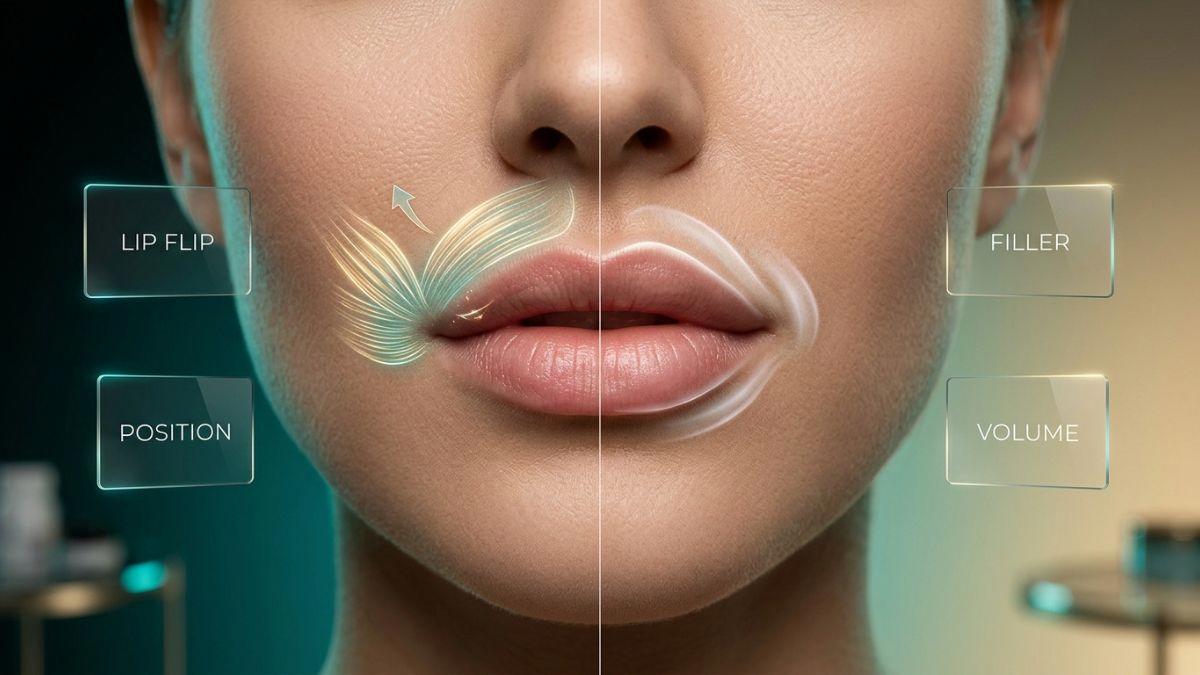
A lip flip uses a small dose of botulinum toxin to relax the upper lip muscle, so the lip rolls slightly outward and shows more pink. Lip filler uses hyaluronic acid gel to add real volume and reshape the lip. A flip is subtle and lasts weeks. Filler is visible, lasts months, and can be dissolved if you change your mind.
Most people asking about lip treatments are not asking for bigger lips. They want the upper lip to show a little more. They want the shape evened out. And they are quietly afraid of walking out looking like someone else. That fear is reasonable, and it explains why the lip flip has become so popular.
The problem is that a lip flip and lip filler get discussed as if they were two settings on the same dial. They are not. The products are different, the tissue they act on is different, and the results last for very different lengths of time. Picking the wrong one usually means paying for a result that treatment could never produce.
This guide covers what each option actually does, who tends to suit which, what recovery and risk look like, and how to match the treatment to your goal. Where the evidence is thin, we say so rather than filling the gap with confidence.
Both treatments involve a needle and the same small area of your face. That is roughly where the similarity ends.
A lip flip is a small dose of botulinum toxin injected into the muscle that circles your mouth, placed so the upper lip relaxes and rolls slightly outward. The muscle is the orbicularis oris. When part of it relaxes, the lip stops tucking under as firmly, and more of the pink vermilion shows.
Nothing is added to the lip. The tissue you see afterwards is tissue you already had, sitting in a slightly different position.
One point deserves attention before you book. Botox Cosmetic carries FDA approval for frown lines, crow's feet, forehead lines, and platysma bands, according to its FDA prescribing information. Lip flipping is not on that list, which makes it an off-label use. Off-label use is legal and common in aesthetics, but the label itself notes that safety and effectiveness for unapproved uses have not been established. The published research on lip flips is also small, mostly case reports and short series rather than large trials.
Lip filler is a hyaluronic acid gel injected into the lip to add volume and structure. Hyaluronic acid is a sugar molecule your body already produces, so the gel works with tissue rather than sitting in it as a foreign object. The FDA approves absorbable fillers for lip augmentation in adults over the age of 21.
These fillers are temporary by design. Your body breaks the gel down gradually, which is one reason many first-time patients find them less frightening than a permanent change.
The table below compares the two on the points that usually decide the choice.
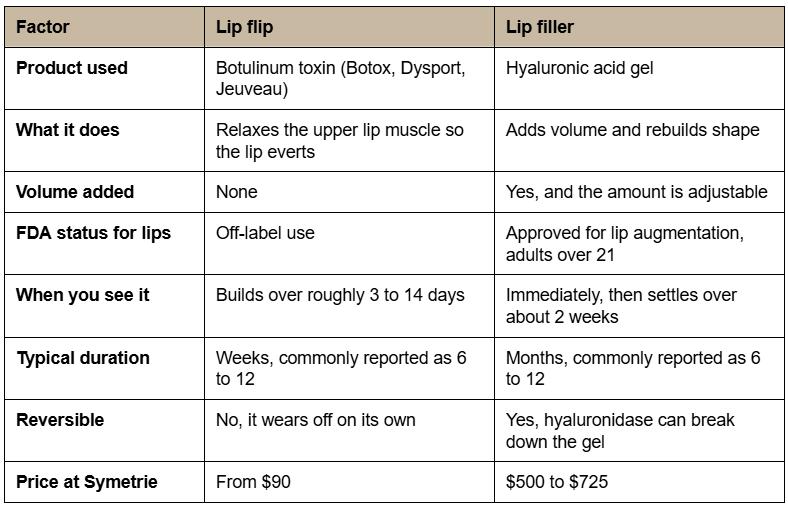
One caution about the duration figures. They come from clinical practice and product experience, not from head-to-head trials comparing the two treatments. Your own timeline may sit outside those ranges.
Botulinum toxin blocks the chemical signal that tells a muscle to contract. Injected in a very small dose along the upper lip, it partially relaxes the fibres that pull the lip inward and downward. With that pull reduced, the lip rests in a slightly rolled-out position and more of the pink border becomes visible.
The doses used here are tiny compared with a forehead treatment. That is deliberate. The muscles around your mouth control speech, drinking, and eating, so precision matters far more than strength.
Those same muscles also work constantly, which injectors generally cite as the reason a lip flip fades sooner than a frown line treatment. Treat that as practical observation rather than a proven rule.
Filler works by physically occupying space. The gel sits in the lip and binds water, which creates fullness you can see and feel. Where it goes determines what changes. Gel placed in the body of the lip creates volume, while gel along the vermilion border sharpens definition. Symmetry Studio Spa uses FDA-approved HA fillers and selects between needles and cannulas depending on the area and the plan.
Different HA products have different thicknesses and lifting strength. Softer gels are usually favoured for lips because the tissue is mobile and thin. For most first-time patients, though, the amount used and the placement matter more than the brand on the syringe.
A lip flip cannot add volume at any dose. Increasing the units does not create fullness. It increases the chance of trouble with speaking, whistling, or drinking from a straw, which is why conservative dosing is the standard approach.
Filler works the other way around. It can build a border, correct asymmetry, and restore lost volume, but it cannot change how a muscle behaves. If your upper lip disappears specifically when you smile, that is a muscle pattern, and filler alone may not address it.
There is a second technical point worth knowing. Botulinum toxin units are specific to each product. The Botox Cosmetic label states plainly that its units cannot be compared with or converted into units of any other botulinum toxin product. So a price per unit for one brand tells you nothing useful about another brand until you know how many units your treatment needs.
Ready to take the next step? Book a consultation with a qualified permanent makeup artist.
Book Now
A lip flip adds no volume whatsoever. The visible change comes from exposed vermilion, often on the order of a millimetre or two of extra pink. In photographs, it can be hard to spot unless you compare directly.
Filler produces a measurable increase in size, and you control how much. If your goal is for other people to notice a difference, filler is the treatment that delivers it.
Filler is the more versatile tool for shape. It can define a soft vermilion border, restore a flattened Cupid's bow, balance an upper lip against a fuller lower lip, and improve mild asymmetry.
A lip flip mainly affects how the upper lip rolls. It cannot rebuild a border that has thinned. Some small studies have reported reduced fine vertical lip lines after botulinum toxin around the mouth, though the sample sizes are too small to treat that as an established benefit.
A lip flip is fast. It usually involves a few very small injections and takes only minutes, and many people go ahead without numbing.
Filler takes longer and involves more injection points. Symmetry offers numbing cream, dental blocks, and ice for comfort, and reports that most clients rate the discomfort around 3 to 4 out of 10. Lips bruise more readily than most areas, so plan around anything important in the following week.
A lip flip is not immediate. The effect builds over several days and reaches its peak at roughly two weeks. Judging your result before then almost always leads to unnecessary worry.
Filler is visible straight away, but the first few days are swelling rather than the true result. Lips typically swell for 3 to 5 days, and the settled outcome shows at about two weeks.
For duration, lip flips are commonly described as lasting a matter of weeks, while lip filler is generally quoted in months. Symetrie's own guidance puts lip filler at roughly 6 to 9 months, with metabolism and lifestyle affecting the number. Faster metabolisms tend to break filler down sooner.
Symetrie Studio Spa publishes its injectable pricing, which makes the comparison concrete:
The sticker price makes a flip look like the budget option, and for a single visit it is. The picture changes over a year. A flip maintained continuously means several appointments, and the annual total can land close to what one or two filler visits cost. If your budget is the deciding factor, compare twelve months of each rather than one appointment of each.
Symetrie also offers financing through CareCredit, Affirm, Afterpay, and Cherry, and applies a deposit at booking that goes toward your service total.
This is the difference that reassures nervous first-timers most. HA filler can be broken down early using hyaluronidase, an enzyme that dissolves the gel. Symmetry lists filler dissolving from $250. Worth knowing: the FDA has noted that hyaluronidase has not been evaluated and approved for this specific use, even though professional bodies have published recommendations supporting it. It is established clinical practice rather than an approved indication.
Botulinum toxin has no reversal agent. Once it is placed, a lip flip has to wear off in its own time. The short duration limits the consequences, but you cannot undo it on request.
The ideal scenario is a lip that has decent volume at rest but seems to vanish when you smile or talk. That happens when the muscle curls the lip inward. Relaxing part of that muscle lets the lip stay visible through movement.
Set your expectations at the right scale. The change is measured in millimetres, and it is meant to look like a good day rather than a treatment.
A useful distinction gets blurred here, and it affects what you should ask for. A lip flip targets the muscle around the mouth. Classic gummy smile treatment usually targets the muscles that lift the upper lip, higher up near the base of the nose. They are related techniques, not the same injection.
Clinical studies of botulinum toxin for gummy smile have reported the strongest reduction in gum display at around two weeks, with the effect gradually returning toward baseline by roughly six months. One prospective study using electromyography followed patients on exactly that timeline. Both uses are off-label, and dosing needs to stay conservative, since higher doses have been linked to upper lip drooping and asymmetry.
A lip flip may suit you if:
It is probably the wrong starting point if:
There are also medical reasons to postpone or avoid it. Botulinum toxin products are contraindicated where there is infection at the injection site or a known hypersensitivity to any botulinum toxin preparation. The FDA advises that cosmetic botulinum toxin injection is not recommended during pregnancy or breastfeeding. Any neuromuscular condition needs to be raised with your injector before treatment, and your medical history should be reviewed properly rather than skimmed.
Lips change with time. The vermilion thins, the lip flattens, and the distance between the nose and the lip tends to lengthen. Filler can restore volume that has been lost, which is a different job from making naturally small lips larger.
For age-related change, restoration usually produces a more natural outcome than enlargement, because you are rebuilding a shape your face already knows.
Shape work is where a skilled injector earns their fee. Small amounts placed along the border, at the Cupid's bow, or at the corners can change how balanced your mouth looks without changing its size much at all.
Nearly everyone has some natural lip asymmetry, and filler can soften it. Complete symmetry is not a realistic target, and chasing it usually leads to overfilling.
Lip filler may suit you if:
Reconsider or delay if:
That last point matters more than any technical factor. A good injector will decline treatment when the goal seems unlikely to bring the satisfaction you are hoping for.
Ready to take the next step? Book a consultation with a qualified permanent makeup artist.
Book Now
For a lip flip, wait the full two weeks before forming an opinion. The effect arrives gradually, and the difference is subtle by design.
For filler, the first days show swelling, not your result. Photographs taken at day two will look fuller than your settled lips at week two. Comparing yourself to social media images is a reliable route to disappointment, since many of those results involve more product than a natural look requires.
Both treatments share mild, short-lived effects at the injection site, including redness, swelling, tenderness, and bruising.
Filler brings the most swelling of any facial area when placed in the lips, typically for 3 to 5 days. Most people return to work the same day and simply avoid intense exercise for 24 hours. Makeup usually covers bruising after the first day.
A lip flip has its own set of temporary quirks. Some people notice slight difficulty pronouncing sounds such as p and b, whistling, or drinking through a straw. These effects follow the same timeline as the treatment and settle as it wears off.
Serious complications are uncommon, but you should know the warning signs before treatment rather than after. For fillers, the FDA identifies unintentional injection into a blood vessel as the most concerning risk. Blocked blood flow can cause tissue death, vision problems including blindness, or stroke. The chance is low, but the consequences can be permanent.
Contact your provider urgently, and seek emergency care if needed, if you notice:
The FDA also notes that swelling or redness can appear near filler sites after illness, infection, vaccination, or dental procedures, sometimes well after treatment. Mention any filler history to other clinicians who treat you.
Botulinum toxin products carry a boxed warning for distant spread of toxin effect. Swallowing, speech, or breathing difficulty after any botulinum toxin injection needs immediate medical attention. The label also records that serious adverse reactions have been reported in patients treated for unapproved uses, which is another reason to keep lip flip dosing conservative and the injector experienced. The FDA additionally advises against buying filler products online and recommends choosing a licensed, trained provider. At Symetrie, injections are performed by licensed nurse practitioners or registered nurses.
Because each treatment has a ceiling the other does not. Someone can have well-placed filler and still watch their upper lip roll under every time they smile, because that is muscle behaviour, not volume. Adding more filler to solve it usually produces a heavy result instead.
Filler supplies volume, structure, and border definition. The flip contributes eversion and, in the right candidate, less gum display. Together they can address size and dynamic movement in a way neither manages alone.
Many injectors stage the two rather than doing both at once, so the effect of each can be assessed separately. Published evidence for combined protocols is limited, so treat sequencing as professional judgment rather than an established standard.
Combining may be worth discussing if:
Be realistic about what combining changes. The flip stays subtle no matter what it sits alongside. Combining is not a way to squeeze extra volume out of a treatment that does not create volume, and it does mean two sets of appointments and two sets of costs.
Best Choice for Subtle Enhancement
A lip flip fits naturally here, since it cannot produce a dramatic result even if you wanted one. That said, subtlety is not exclusive to the flip. A small, conservatively placed amount of filler can also look understated. Subtlety depends far more on dose and injector judgment than on which product is chosen.
Best Choice for Added Volume
Filler, without qualification. It is the only one of the two that adds anything to the lip. If more fullness is the goal, a lip flip will disappoint you regardless of how it is performed.
Best Choice for a Gummy Smile
Botulinum toxin is the usual starting point, but the injection site depends on why you show gum. If the cause is a hypermobile upper lip, muscle relaxation can help. If it relates to tooth position, gum tissue, or jaw structure, injections will not correct it, and a dental or oral surgery opinion is the more useful next step. Ask for that assessment before assuming injectables are the answer.
Best Choice for Shape and Symmetry
Filler again, because shape work needs a material that can be placed exactly where structure is missing. A flip changes how the lip sits, but it cannot build a border or balance one side against the other.
Best Choice for Longer-Lasting Results
Filler holds for months, whereas a flip holds for weeks. If fewer appointments matter to you, that gap is significant. Keep in mind that longer-lasting also means longer to live with a result you are unsure about, which is where the option to dissolve becomes reassuring.
The decision rarely comes down to which treatment is better. It comes down to whether your concern is position or volume. If your lip has enough tissue but hides when you smile, a flip addresses that directly. If the tissue itself is thin, or the shape needs rebuilding, filler is the tool that can do it.
Cost, duration, and reversibility then refine the choice. A flip is cheaper per visit but needs frequent repeating. Filler costs more upfront, lasts far longer, and can be dissolved if you dislike the outcome. Neither is risk-free, and both depend heavily on the anatomy in front of the injector and the judgment of the person holding the syringe.
That last part is not something an article can settle for you. A short assessment of how your lip moves, how much tissue you have, and what you actually want to change will tell you more than any comparison table. Symetrie Studio Spa offers complimentary consultations on all services at 5521 Ambassador Caffery Pkwy, Suite 100 in Youngsville, and small adjustments within two weeks of filler treatment are included at no extra charge.
Book a lip consultation to get a personalized recommendation, or call (337) 534-0852 to talk it through first. Bring your questions and, if it helps, a photo of the result you have in mind. Honest answers about what each treatment can and cannot do are far more useful than a booking made on a guess.
Ready to take the next step? Book a consultation with a qualified permanent makeup artist.
Book Now