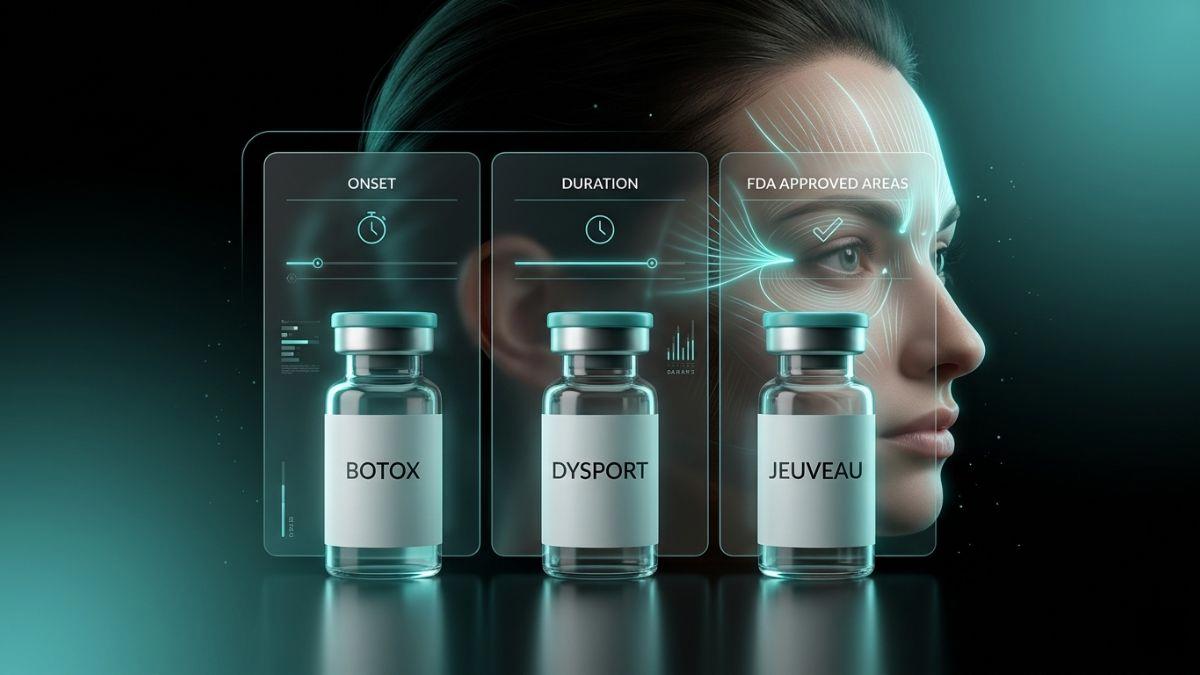
Botox Cosmetic, Dysport, and Jeuveau are all botulinum toxin type A injectables that temporarily relax the muscles creating expression lines. They differ in formulation, in the number of labeled units used per treatment, and in which facial areas carry FDA approval. All three are approved for frown lines between the brows, and their potency units cannot be converted from one product to another.
Standing in front of a mirror deciding whether to book your first neurotoxin appointment is one thing. Choosing between three brand names that sound almost identical is another. If you have already searched this topic, you have probably found pages that say Dysport works faster, Botox is more precise, and Jeuveau is the budget option, usually with no explanation of where those claims come from.
Some of those statements trace back to FDA-approved prescribing information. Others come from clinical practice patterns, and a few come from marketing. Those categories carry very different weight, and separating them is the difference between an informed choice and a guess.
This comparison sticks to what the product labeling and published trials actually establish, flags where the evidence thins out, and shows how the differences translate into a real decision at a med spa. By the end, you should know which questions to raise at your consultation and why your injector may recommend a product you were not expecting.
The table below pulls the concrete, verifiable differences into one place. A few cautions before you read it. The onset and duration figures come from each product's own labeling and pivotal trials, which used different study designs, different endpoints, and different patient groups. Numbers from separate studies are not the same thing as a head-to-head comparison, so treat the rows as product-specific facts rather than a race.
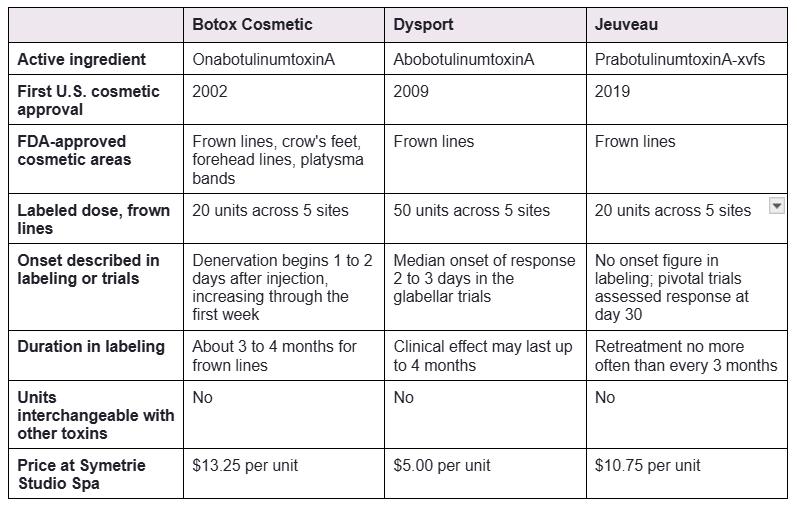
The similarities matter more than most comparison pages admit. All three are purified botulinum toxin type A, all three are prescription medications that require a qualified injector, and all three work through the same biological pathway. Each one carries the same FDA boxed warning about toxin effects spreading beyond the injection site.
Their approved cosmetic indication overlaps as well. Every one of the three is FDA-approved for the temporary improvement of moderate to severe glabellar lines, the vertical creases that appear between your brows when you frown. Treatment appointments run short, involve no anesthesia beyond optional numbing cream, and allow you to return to normal activity the same day.
None of them fills a line. If a crease is visible when your face is completely relaxed, a neurotoxin will soften it at best. Static lines etched into the skin usually need a different approach, which is one reason your injector examines your face at rest and in motion before recommending anything.
Three differences are established rather than debated. First, the accessory proteins and excipients surrounding the active toxin are not the same across products. Second, the potency assay used to define a unit is specific to each manufacturer, so the numbers on a treatment plan do not translate across brands. Third, the range of FDA-approved cosmetic areas differs substantially, with Botox Cosmetic holding several and the other two approved for frown lines alone.
A fourth difference, how widely each product spreads through tissue, gets discussed constantly in clinics and is covered in its own section below. The evidence there is more mixed than the confident claims online suggest.
Botulinum toxin type A is a purified protein that blocks the release of acetylcholine, the chemical messenger a nerve uses to tell a muscle to contract. With that signal interrupted, the injected muscle relaxes. The effect is local, temporary, and dose-dependent, and it wears off as nerve terminals recover their ability to release the messenger again.
This is why the treatment is described as a neuromodulator rather than a filler. Nothing is added to plump the skin. A specific muscle is asked, chemically, to stop pulling as hard.
Dynamic wrinkles form perpendicular to the direction a muscle pulls. Squinting, frowning, and raising your brows fold the skin along the same lines thousands of times, and over the years those folds stop bouncing back completely. Relaxing the muscle underneath reduces the folding, and the overlying skin has a chance to smooth out.
That mechanism also explains the limits. Sun damage, volume loss, and skin laxity are not muscle problems, so a neurotoxin will not correct them. It also explains why many people in their late twenties and thirties begin treatment before deep lines appear, since reducing repeated folding is easier than reversing a line already set into the skin.
Approval history is worth understanding because it determines what each product is officially allowed to treat, and that shapes what your injector can offer on-label.
Botox Cosmetic received its first aesthetic FDA approval in 2002 for moderate to severe glabellar lines, followed by crow's feet lines in 2013 and forehead lines in 2017. Its current labeling also covers platysma bands in the neck. That makes it the only one of the three with FDA-approved cosmetic indications beyond the frown lines.
The labeled dose for glabellar lines is 20 units divided into five injection sites, 24 units for crow's feet, and 20 units for forehead lines given alongside glabellar treatment. The labeling caps the cumulative dose at 360 units in any three-month period across all indications.
Dysport received FDA approval for glabellar lines in 2009, after years of therapeutic use in other countries. Its labeled cosmetic dose is 50 units given in five equal 10-unit injections, and the labeling states the clinical effect may last up to four months, with retreatment no more often than every three months.
One safety detail deserves attention because it is specific to this product. Dysport may contain trace amounts of cow's milk protein, and the labeling states that patients known to be allergic to cow's milk protein should not be treated with it. This is a milk protein allergy, not lactose intolerance, and the two are unrelated. Mention any history of dairy allergy during your medical history review.
Jeuveau, sometimes marketed as "Newtox," received FDA approval in 2019 for moderate to severe glabellar lines. Unlike the other two, it has no therapeutic indications at all. Its labeling states plainly that it is not approved for spasticity or any condition other than glabellar lines, which is where its aesthetics-only positioning comes from.
Its labeled dose is 20 units divided across five sites, the same arithmetic as Botox Cosmetic for the same area. That numerical match is convenient, but it is not an official conversion, and the labeling still states the units are not interchangeable.
Each product pairs the active toxin with a different set of accessory proteins and stabilizers. Dysport is formulated with human serum albumin and lactose. The others use their own excipient profiles, and each manufacturer measures potency with its own proprietary assay.
Here is where a lot of online comparisons overreach. Molecular size and accessory protein content are real differences, but a biochemical difference does not automatically produce a predictable difference in how your forehead looks in two weeks. Some formulation-based explanations for spread and onset remain hypotheses supported by indirect evidence rather than settled clinical fact. A careful injector treats them as considerations, not rules.
Ready to take the next step? Book a consultation with a qualified permanent makeup artist.
Book Now
Botox Cosmetic's prescribing information describes chemical denervation of the injected muscles typically beginning one to two days after injection and increasing in intensity during the first week. Dysport's glabellar trials reported a median time to onset of response of three days in two studies and two days in a third, with a subset of participants reporting a change as early as day one. Jeuveau's labeling does not state an onset figure; its pivotal trials measured response at day 30.
Read those numbers as three separate measurements, not a ranking. The studies used different designs and different definitions of a response, and the difference between products is smaller than the difference between two people receiving the same product. Practically, a couple of days either way rarely changes a decision unless you have an event on the calendar.
For frown lines, Botox Cosmetic labeling gives a duration of roughly three to four months. Dysport labeling states the clinical effect may last up to four months. Jeuveau labeling advises retreatment no more frequently than every three months. In practice, the three sit in a similar range, and none of them is established as the long-lasting option for cosmetic use.
What actually moves your personal duration is more mundane: how strong the treated muscle is, how much product was used, which area was treated, and your own metabolism. Someone with a powerful frown muscle who received a conservative dose will notice movement returning sooner, regardless of the brand on the vial.
Full effect generally lands around two weeks after treatment, once the relaxation has built to its peak. Judging your outcome before that point is the most common mistake first-time patients make. The forehead can look uneven at day four and completely even at day twelve, simply because different muscles respond at slightly different rates.
Plan around that timeline. If you want to look your best for a wedding or a photographed event, schedule roughly two to three weeks ahead. That leaves room for the product to reach full effect and for a follow-up assessment if one area needs attention.
Spread, sometimes called diffusion, describes how far the product travels from the needle tip through surrounding tissue. It is the most-discussed difference between these products and the least firmly established. Dysport is widely described in clinical practice as spreading somewhat more broadly, which injectors often prefer across large flat surfaces such as the forehead, where even coverage from fewer injection points is an advantage.
Botox and Jeuveau are commonly described as staying nearer the injection point, which injectors often prefer for small, delicate targets where a millimeter of unwanted spread produces a visible problem. Around the eyes and brows, unintended relaxation of a neighboring muscle can cause a drooping lid or an uneven brow.
Two caveats keep this honest. Spread behavior is influenced heavily by how the product is reconstituted, what volume is injected, and how deep the needle sits, which means technique can outweigh the product itself. And these practice patterns are not the same category of evidence as an FDA-labeled fact. They are reasonable professional judgments that experienced injectors apply case by case.
Each manufacturer defines a unit using its own potency assay, with its own reference standard and laboratory protocol. The FDA labeling for Botox Cosmetic, Dysport, and Jeuveau each states that its units are specific to that preparation and cannot be compared to or converted into units of any other botulinum toxin product.
That is a regulatory statement, not a technicality to work around. Fifty units of Dysport is not five times more medicine than ten units of Botox. The number simply belongs to a different measuring system, the way a temperature reading means nothing until you know whether it is Celsius or Fahrenheit.
The clearest way to compare the two is by looking at the labeled dose for the same treatment area. For frown lines, Botox Cosmetic uses 20 units, and Dysport uses 50 units, both divided across five injection sites. Ratios in the range of two-and-a-half to one appear in the clinical literature, and Dysport's therapeutic studies have examined a 2.5:1 ratio against Botox.
Those ratios describe study conditions and clinical practice, not an official conversion formula, and no regulatory body endorses converting a prescription this way. Ask your provider what a full treatment of your area costs in that product's units, and compare treatments rather than numbers.
Dosing starts with an examination, not a menu. Your injector watches you frown, raise your brows, and squint to see which muscles are doing the work and how strongly. Muscle bulk, brow position, eyelid skin, prior treatment history, and how much movement you want to keep all feed into the number.
Men often need higher doses in the same area because of greater muscle mass. Someone with a heavy brow or significant upper eyelid skin may need a conservative forehead dose to avoid worsening the heaviness. If you have had treatment before, what worked and what did not is genuinely useful information, so bring your history and any past treatment records with you.
This section separates FDA-approved uses from off-label uses. Off-label means a product is being used outside some element of its approved labeling. It is legal for a licensed provider to prescribe that way, and it is common across medicine, but it is not the same as FDA approval, and the appropriateness of any off-label use is a matter of professional judgment for your specific case.
The horizontal lines across your forehead come from the frontalis, a broad flat muscle that also holds your brows up. Botox Cosmetic is FDA-approved for moderate to severe forehead lines, with labeling that pairs the forehead treatment with glabellar treatment. Using Dysport or Jeuveau on the forehead is an off-label use.
This area calls for restraint from your injector. Because the frontalis lifts the brows, over-relaxing it can leave the brows sitting lower and the upper lids feeling heavy. Injectors often treat the frown complex alongside the forehead for this reason, since those muscles pull in opposing directions.
The vertical creases between the brows come from the corrugator and procerus muscles. This is the one area where all three products carry FDA approval, which makes it the cleanest comparison of the group and the area where the most trial data exists for each.
If frown lines are your only concern, all three are reasonable on-label options, and your decision can come down to cost, onset preference, and your injector's assessment of your anatomy.
The fan of lines at the outer corners of your eyes comes from the orbicularis oculi, a thin superficial muscle ringing the eye. Botox Cosmetic is FDA-approved here, with a labeled dose of 24 units divided between the two sides. Dysport and Jeuveau in this area are off-label.
Precision matters more here than almost anywhere else on the face. The muscle is thin, sits close to the skin, and neighbors muscles that control your eyelid and your smile. Product placed too far inward can flatten your smile on that side.
Beyond the upper face, neurotoxins get used for a lip flip, bunny lines on the nose, chin dimpling, a subtle brow lift, jaw slimming through the masseter muscle, and neck bands. Botox Cosmetic's labeling now includes platysma bands. Most of the remaining uses in this list fall outside approved labeling for all three products.
Symetrie Studio Spa offers a lip flip as a listed service. If you are curious about any area outside the frown lines, raise it at your consultation so your injector can tell you what is approved, what is off-label, and whether your anatomy suits the request.
Ready to take the next step? Book a consultation with a qualified permanent makeup artist.
Book Now
Neurotoxin pricing at most practices, including ours, works on a per-unit basis. Your total therefore depends on how many units your treatment plan calls for, which depends on the area, your muscle strength, and how much softening you want. Two people can sit in the same chair for the same area and leave with different totals.
Payment options can affect what you actually spend across a year. We offer financing through CareCredit and participate in the Allē rewards program for Botox and other Allergan products, and we run membership programs and seasonal specials that some clients use to reduce ongoing costs.
A per-unit price tells you almost nothing on its own, because a unit means something different in each product. Our current pricing lists Botox at $13.25 per unit, Jeuveau at $10.75 per unit, and Dysport at $5.00 per unit.
Read quickly, Dysport looks less than half the price of Botox.
It is not, because the labeled dose for the same area is two and a half times higher. Any clinic advertising a cheap per-unit price on a product that requires more units per treatment is quoting a number that does not answer the question you are actually asking.
Run the arithmetic on the frown lines, where every product carries FDA approval, and each has a labeled dose. Using our per-unit pricing and the labeled doses, the totals are:
The gap between the least and most expensive comes to $50 for the treatment, not the several hundred dollars the per-unit prices might imply. These are illustrative figures based on labeled doses, and your actual dose is set during your appointment, so treat them as a way to compare rather than as a quote.
Full current pricing for injectables and other services is listed on our site, and the details of each product we carry are on our Botox, Jeuveau, and Dysport service page.
Reactions reported in the clinical trials for these products include headache, injection site pain or reaction, eyelid drooping, eyelid swelling, and upper respiratory symptoms. Minor bruising, swelling, or redness at the injection sites is common and generally settles within hours to a few days.
Dry eye has been reported with botulinum toxin treatment of glabellar lines. Reduced blinking and reduced tear production can occur, and persistent symptoms are worth reporting to your provider rather than waiting them out.
All botulinum toxin products carry an FDA boxed warning about the effects spreading from the injection area. Symptoms consistent with botulinum toxin effects have been reported hours to weeks after injection, and swallowing or breathing difficulties can be life-threatening. Seek immediate medical care for any difficulty swallowing, speaking, or breathing after treatment.
The labeling notes that these serious outcomes have generally been reported in patients treated for unapproved uses, often at doses higher than those used cosmetically. That context matters, but it does not make the warning irrelevant to aesthetic treatment.
Contraindications listed across these products include known hypersensitivity to any botulinum toxin preparation or its components, and infection at the proposed injection site. Dysport adds known cow's milk protein allergy. A neuromuscular disorder such as myasthenia gravis can amplify the effects of treatment and needs to be disclosed.
If you are pregnant, trying to conceive, or breastfeeding, discuss it with your provider, since human safety data in these situations is limited and eligibility is a clinical decision.
The most consequential variable in your result is not printed on the vial. It is whether the person holding the syringe understands the muscles under your skin, how they interact, and how your face moves. Prescribing information for these products states that the physician administering them must understand the relevant neuromuscular and orbital anatomy, including any changes from previous surgery.
That knowledge is what prevents the outcomes people fear. A drooping eyelid usually reflects a product placed where it should not have been. A frozen forehead usually reflects a dose that ignores how much lift that muscle was providing. Both are technique questions, and switching brands does not solve either one.
At Symetrie Studio Spa, all injections are performed by licensed nurse practitioners or registered nurses, and every treatment begins with a complete medical history review. Reasonable questions to ask any injector include who will perform the injection, what their training in facial anatomy involves, and how they would handle an uneven result.
No single product wins across the board. What follows is a way to organize your own priorities before your consultation, so the conversation with your injector starts from something concrete.
If you want to stay strictly within FDA-approved use for crow's feet, forehead lines, or platysma bands, Botox Cosmetic is the only one of the three approved for those areas. For frown lines alone, all three are on-label, and the area stops being a deciding factor.
If you are treating well ahead of any event, onset differences of a day or two are not worth weighting. If your timeline is genuinely tight, mention the date at your consultation. Dysport's reported median onset in its glabellar trials was two to three days, which some injectors take into account, though the responsible framing is that individual variation is larger than the difference between products.
Duration is not a strong differentiator among these three. All sit in a broadly similar range for frown lines, and no reliable evidence establishes one as the longest-lasting cosmetic option. If longevity is your priority, the more productive conversation is about dosing adequacy and treatment intervals rather than brand.
For broad, flat areas where even coverage is the goal, some injectors favor a product described as spreading more widely. For small, delicate targets near the eye or brow, many favor tighter placement. This is a professional judgment your injector makes after watching your face move, and it is one of the better reasons to let their recommendation override a preference you formed online.
Compare total treatment cost for your specific area, never the per-unit rate. Ask what your plan costs in full, ask how often you would return, and ask about membership programs, financing, or rewards enrollment before you book. Yearly cost is the number that affects your budget, and it depends more on the size of your treatment plan than on which of the three products you receive.
Yes, switching between products is possible, and your provider will recalculate the dose rather than carrying your old number across, since units do not convert. Tell your new injector which product you had, how many units, and when, because retreatment intervals and cumulative dose still apply across brands.
Some injectors use different products in different areas during a single visit, though this is a clinical decision rather than a labeled protocol. Prescribing information advises considering the cumulative dose when more than one botulinum toxin product is used, and the safety of combining products has not been established through labeling. Ask your injector directly whether they do this and why.
Most people who switch report a comparable outcome when the new product is dosed appropriately for the area. Small differences in how a result feels can come from dose, placement, or spread rather than the molecule itself. Give a new product a full two weeks before judging it, and tell your injector specifically what feels different so they can adjust placement next time.
Botulinum toxins are proteins, and the labeling for these products acknowledges a potential for the immune system to form antibodies. True resistance is uncommon in cosmetic dosing, which uses far less product than therapeutic treatment. Because formulations differ in their protein content, switching products is sometimes discussed as an option for someone who has stopped responding, but this is an area where the evidence is limited and a medical evaluation matters more than a brand change. If your results have faded noticeably over several cycles, raise it with your provider rather than assuming resistance.
The honest answer to the comparison is that these three products are more alike than the marketing around them suggests. They share a mechanism, a safety profile shaped by the same boxed warning, and an overlapping approval for frown lines. Where they genuinely part ways is in approved treatment areas, in the dosing units that make per-unit prices misleading, and in the practice patterns injectors apply when matching a product to a particular muscle.
That last point is where your decision actually gets made. A recommendation depends on your muscle strength, brow position, eyelid anatomy, treatment history, and how much movement you want to keep, and none of that can be assessed from a comparison table.
At Symetrie Studio Spa in Youngsville, we carry all three products, and consultations are free. Book a consultation and one of our injectors will review your medical history, assess how your face moves, and recommend the product and dose suited to your anatomy and your goals. You can schedule online or call us at (337) 534-0852.
Ready to take the next step? Book a consultation with a qualified permanent makeup artist.
Book Now